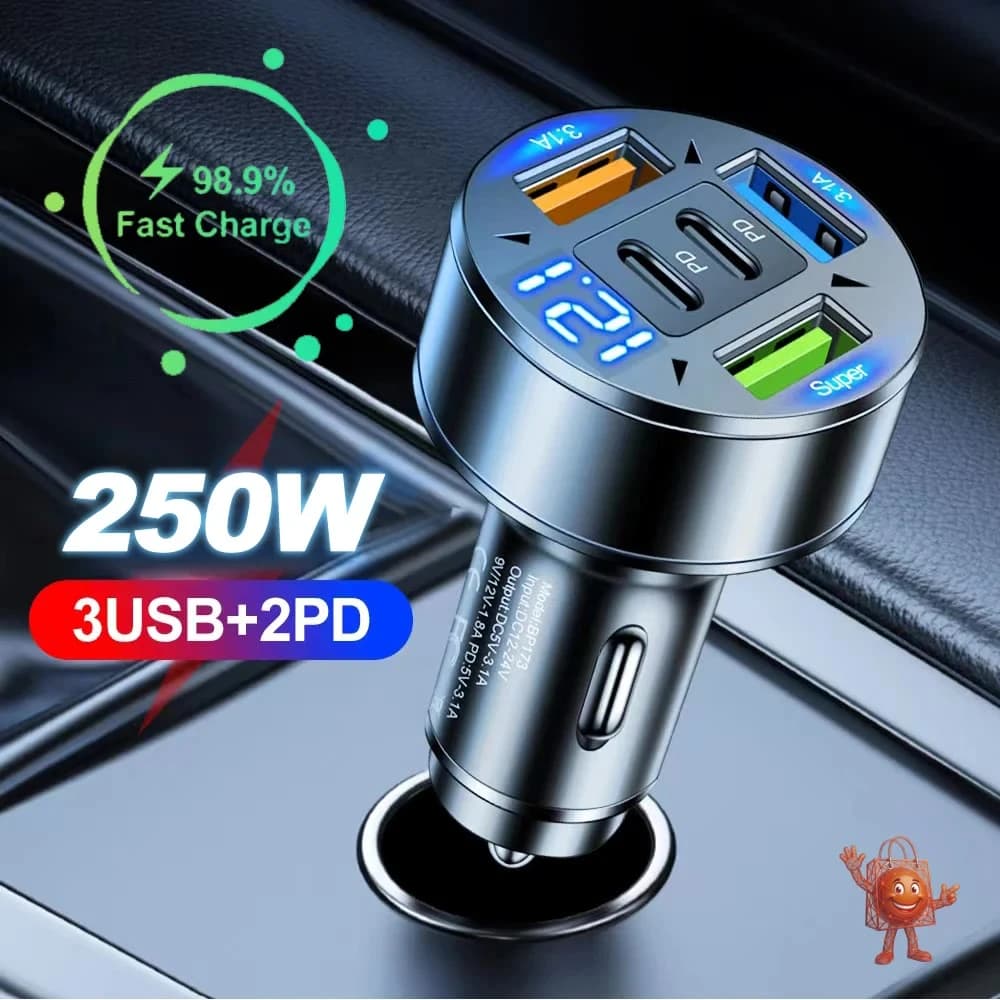
250W 5-Port Car Charger: Honest Review at $2.54
I looked closely at this 5-port PD/QC3.0 car charger. Here's my honest take on whether it's worth it.
Save $2.19 on this deal!
⏰Offer valid for a limited time!
🛒Buy now on AliExpress🔒 Secure payment on AliExpress • Price may change
📋 Detailed description
When your car charger becomes the bottleneck
Here is a situation most people have been in: you leave the house with your phone at 30%, you are relying on GPS the entire drive, and the single-port charger plugged into your car is technically charging — except the battery keeps dropping anyway. It is giving you the illusion of charging while your phone slowly dies.
I started looking into multi-port car chargers after one too many of those trips. What I found at the low end of the market was mostly disappointing — flimsy single-port adapters, vague wattage claims, no fast charging. Then I came across this: a 5-port car charger advertised at 250W with PD and QC3.0 support, compatible with iPhone, Samsung, Huawei, and Xiaomi. Price: $2.54 (was $4.71). It seemed almost too cheap to bother reviewing seriously. Worth noting that sometimes the most useful products hide in this price bracket — so I looked closer.
Honest Review: What actually works and what does not
Let me start with what genuinely impressed me, because there are real positives here.
The fast charging ports are not just a marketing label — reviewers across multiple countries have confirmed the QC3.0 port meaningfully accelerates charge speed on compatible Android devices. One buyer in Japan specifically noted he could charge two smartphones simultaneously using the 3.1A ports and observed no heat buildup, which is a real concern with cheap chargers in enclosed cars. A Spanish buyer described it as fitting securely in the socket without disconnecting — another common failure mode for budget car adapters.
Having five ports is a genuinely useful feature for anyone who drives with passengers or carries multiple devices. The inclusion of a USB-C port with Power Delivery means modern iPhones and newer Android flagships can actually charge at reasonable speeds, not trickle-charge at 5W like they would on older adapters.
Now for the honest limitation, stated plainly: the 250W rating is not real in any practical sense. A standard 12V car cigarette lighter socket cannot physically deliver 250 watts — the math does not work. What this charger actually does is distribute the available power from the car socket across five ports efficiently. That is still useful, but if you go in expecting to fast-charge a power-hungry laptop or sustain 100W output from any single port, you will be disappointed. The 250W figure is marketing, not engineering.
Also worth noting: at this price, you are accepting some uncertainty about component quality and longevity. There is no brand reputation behind this, no local warranty, and no way to verify the internal specs independently. It works well based on available evidence — but it is a calculated risk, not a guaranteed purchase.
Comparison: What does $2.54 normally buy you in this category?
At under three dollars, most car chargers are single-port, slow-charging adapters that get warm to the touch and stop working within a few months. The baseline is genuinely bad in this price range.
Branded multi-port car chargers with legitimate QC3.0 start at around $12-15. Anker, Belkin, or similar brands with USB-C PD and multiple ports will run you $20-35. The premium you pay for those buys you verified specs, consistent quality control, and actual customer support.
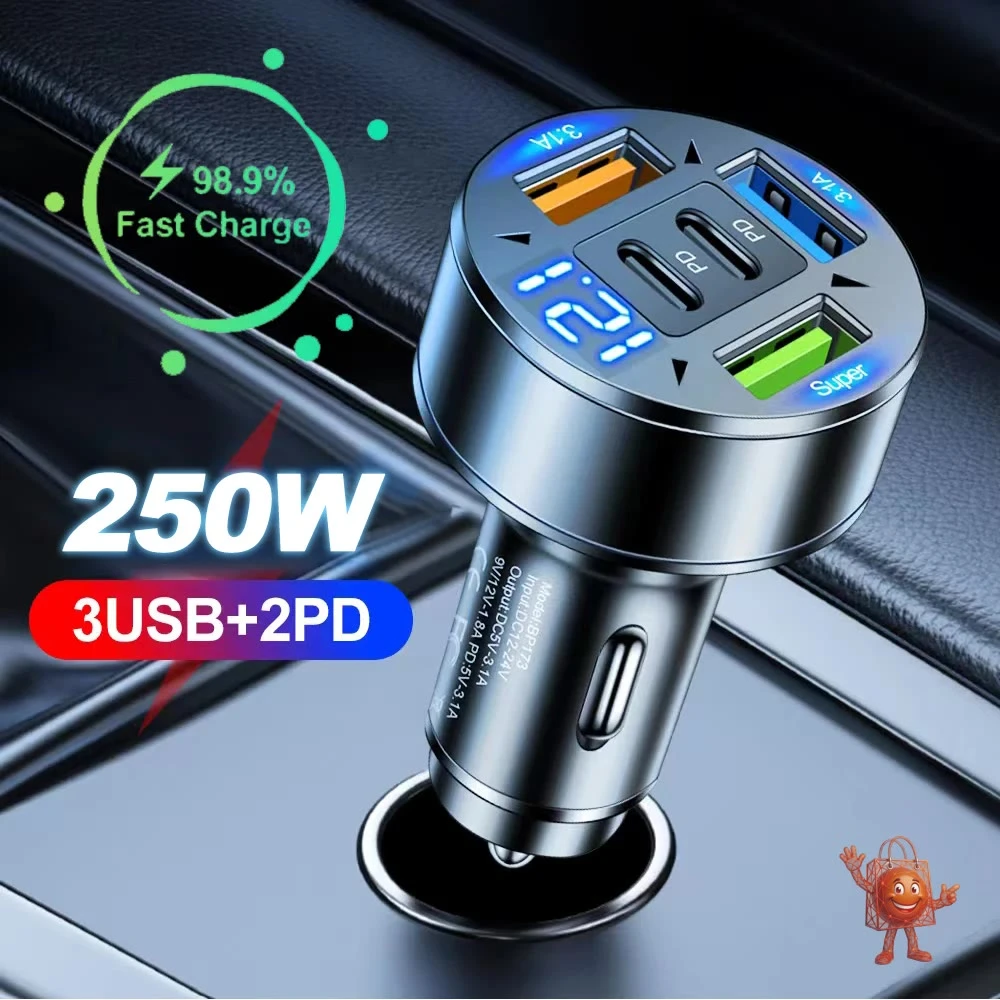
What surprised me about this charger is that it appears to deliver the core functionality — multiple ports, working fast charge, no overheating — at a price point that is roughly one-tenth of what you would spend on a branded equivalent. The trade-off is transparency: you know what you are getting with Anker, and with this you are largely relying on reviews from other buyers to know if the product matches its listing.
For a primary charger you depend on daily, the branded option probably makes more sense. For a backup charger, a charger to keep in a second car, or a travel spare, this is hard to argue against at $2.54.
Buy it if / Skip it if
Buy it if:
- You need to charge multiple devices in the car simultaneously
- You want fast charging support for modern iPhones or Android phones without paying brand-name prices
- You are buying a backup or secondary charger where the stakes are lower
- You drive with family or passengers who always need their phones charged
Skip it if:
- You need to charge a laptop or high-power USB-C device reliably
- You only trust products with verified specs and warranty support
- You took the 250W claim at face value — that number is not what it sounds like
- Longevity and quality consistency are more important to you than upfront cost
My honest take: this is a solid budget car charger that does the essential job well. The fast charging works, the multi-port design is genuinely useful, and at $2.54 the risk of trying it is minimal. It is not a precision piece of electronics — it is a practical accessory at a price that makes the risk easy to accept.
If it matches your situation, you can check it out here: https://www.ali-ex.com/lkot9y
Price: $2.54 (was $4.71). For that price, it earns a look.
🔥 Similar products you might like
More quality products from the same category